



African LNG, a strategic lever for European energy security
Nigeria holds the ninth largest gas reserves in the world, while importing the majority of its LPG. At the same time, Europe has lost approximately 20 % of its LNG supply following the closure of the Strait of Hormuz. These two realities are linked.
They translate the same problem: Africa's gas resources are well identified, but the infrastructure and mechanisms for effectively valuing them have not evolved at the same pace. Bridging this gap is essential, both for African producers and European buyers.
The temporary closure of the Strait of Hormuz in early March 2026 caused the most significant supply disruption the global oil and gas market has experienced recently. In this context, floating LNG projects along the African Atlantic coast have come under sharp focus. The ability to transform this potential into delivered volumes depends less on geology and more on project structuring.
A structural geographical advantage
LNG exports from Nigeria, Senegal, Mauritania, Gabon, and the Republic of Congo bypass both the Strait of Hormuz and the Red Sea. This reduces transport risks, shortens delivery times to Europe, and circumvents two major points of vulnerability in global gas trade.
This advantage already existed, but buyer perception has evolved. Before 2026, Atlantic sourcing was one option among others. After the loss of Qatari deliveries — approximately 16 million tons per year — diversification became a sustainable objective.
The question is no longer so much about the availability of resources as it is about the ability to mobilize them within deadlines compatible with market needs.
Why are African LNG projects falling behind schedule
The observation is recurring. The Mozambique LNG project has been interrupted for over four years due to insecurity in the Cabo Delgado region. The Tanzania LNG project, on the other hand, has been under discussion for over a decade without a final investment decision.
In both cases, the blockage is primarily structural.
Large-scale onshore LNG projects concentrate technical, political, security, and commercial risks at a single decision point. They require the simultaneous commitment of numerous stakeholders with different risk profiles. As soon as one participant hesitates, the project slows down.
The problem generally doesn't lie in the resources, but in how the risk is structured and presented to investors.
A poor risk assessment by the markets
Financial markets often approach the risk of African LNG in a binary way: either a project is financeable or it is not. Political and security risks are perceived as fixed, when in reality they can be mitigated through project design.
This leads to persistent undervaluation. Viable resources remain untapped, not for economic reasons, but because the proposed structures do not align with investor appetite.
A well-structured FLNG project—on a proven field, with secured offtake contracts and multilateral participation—can reach production within two to three years of an investment decision. Solutions based on the conversion of existing LNG carriers or modular units allow for further acceleration of this timeline.
Conversely, an FLNG unit built from scratch generally takes four to five years.
This difference is crucial: applying the same criteria as a $20 billion land-based terminal to a modular floating project leads to inappropriate investment decisions.
The availability of floating units: a key factor
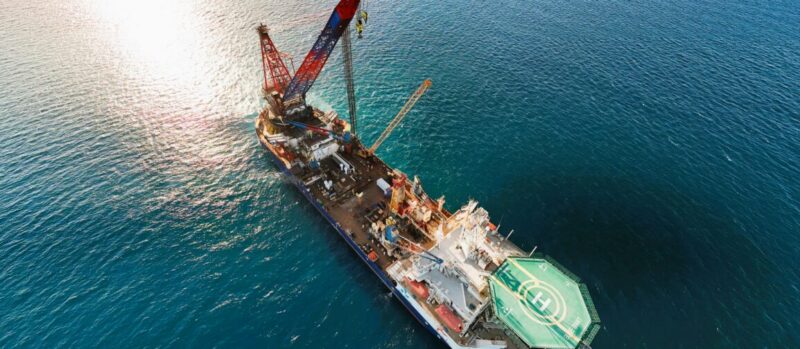
At the end of 2025, eight FLNG projects were operational worldwide, with nine additional units under construction. Considering African resources, this capacity remains limited.
The availability of units—whether new builds, LNG carrier conversions, or the redeployment of existing units—is now a determining factor.
Conversions offer the shortest lead times and are gaining relevance as certain vessels reach the end of their service life.
For project leaders, this implies one thing: the strategy related to floating units must be integrated from the very beginning. Those who secure these capabilities upstream benefit from a competitive advantage that is difficult to catch up on.
FLNG as a market access strategy
Phased development is often presented as a financial tool: reducing upfront costs, limiting risks, validating the reservoir before expansion. This is accurate, but incomplete.
An FLNG unit 1 to 2 million tons per year, launched today on a proven field with secured outlets, can deliver LNG to Europe within a timeframe compatible with the current window.
A land-based project cannot. When it enters production, market conditions will have changed.
Progressive development therefore allows:
- to generate cash flow quickly
- to strengthen operational credibility
- to create a reassuring contractual history for funders
In this context, speed of execution becomes more important than the size of projects.
Africa's advantage lies not only in its resources but also in its ability to mobilize them quickly thanks to floating LNG.
Limited alternatives
After the Strait of Hormuz closure, US LNG terminals were operating at around 94% % of capacity. Any increase requires new infrastructure, which is slow to develop.
Norway, at about 355 million m³ per day in early 2026, already covered nearly 30 % of the combined demand of the EU and the United Kingdom, with little additional capacity.
These sources have supported European diversification since 2022, but are reaching their limits today.
In this context, floating African LNG appears to be a credible short-term solution: favorable geographical conditions, competitive lead times, and primarily administrative obstacles.
Three projects that illustrate this model
Congo LNG – Republic of the Congo
Eni commissioned a first unit in 2024, followed by a second in 2025. The initial operational success facilitated the financing of the next phase.
Coral South FLNG – Mozambique
This project operated by Eni passed the milestone of 100 shipments in April 2025. This performance has secured financing for the Coral North project.
Greater Tortue Ahmeyim - Mauritania / Senegal
Developed notably by BP, the project reached its first production at the end of 2024, with exports in 2025. The next phase is in preparation.
Projects that fail often have one thing in common: they aim to achieve large scale immediately.
The key role of public policies
Tax frameworks designed for large onshore projects can penalize modular FLNG projects. Applying the same rules to projects of different sizes creates imbalances.
Countries like Nigeria, Mozambique, Senegal, and the Republic of the Congo are moving in the right direction. The main challenge remains clarity.
Defining appropriate tax conditions upstream for FLNG projects allows investors to structure their financing with greater visibility.
For states with strategic resources, this is the most direct lever for attracting capital.
Moore Global
Moore Global supports companies, investors, and energy sector players with industry expertise and an international presence.
Contact the Moore Global Energy and Mines team to analyze the impact of these developments on your strategy.